My newsletter response to Representative Connolly

Setting the record straight

A point-by-point response to Rep. Connolly's newsletter, with Mayor Sumbul Siddiqui on the record about who actually fought for affordable housing.

In Mayor Siddiqui's Words
“The proposal to add housing did not originate with Mike Connolly. He opposed the redevelopment and asked me not to support it.”
— Sumbul Siddiqui, Mayor of Cambridge
Mayor Sumbul Siddiqui

This week, our first mailer arrived in voters' mailboxes, laying out my plans and record as a housing advocate. Rep. Connolly sent out a campaign newsletter the same day it arrived, calling our mailer “misinformation.” It's unfortunate that, after a decade in office with no competition, a long-time elected official describes our straight-forward look at his record with such strong language. Honesty is a core principle for me, and the mailer links to NeilMillerMA.com/housing, which provides direct citations for every single claim. And here is the point-by-point documentation for each item in my mailer: sources.

However, this did not prevent Rep. Connolly from describing the mailer as dishonest. Voters deserve to have all the facts when they make their choice, so we have written out an even more comprehensive response to Rep. Connolly's newsletter. To be as brief as possible, addressing each point:

The mailer in question
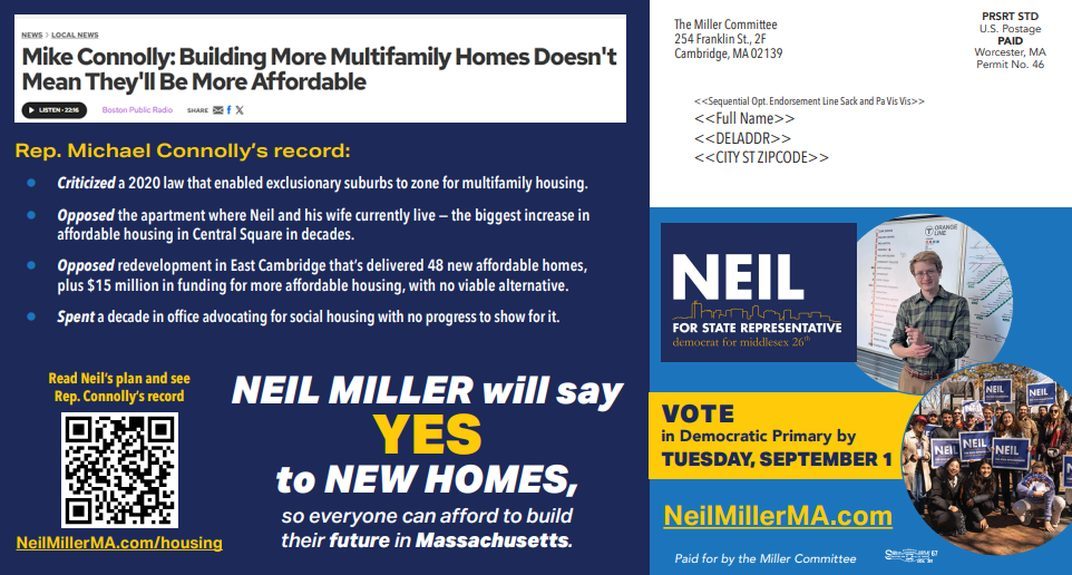
Neil Miller mailer, back panel: Rep. Michael Connolly's record
My mailer said he “criticized” a 2020 housing law which enabled exclusionary suburbs to build more multifamily housing. Indeed, in the linked article from GBH, Connolly said: “It's a one-sided proposal. It's a proposal that real estate industry lobbyists and municipal lobbyists agreed to.” This criticism arises from his argument, reflected in the article's headline, that building more multifamily housing around the state won't help affordability.
The mailer says he opposed the apartment building where my wife and I now live. Rep. Connolly said he actually wanted more housing, by including a city-owned parking lot. He can make the case that he had a feasible, superior alternative, but Connolly's efforts as a council staffer, organizer, and candidate were directly opposed to the mixed-income buildings that currently exist:
  • Connolly was working in 2015 as an aide for a City Councillor who likened the relevant Central Square rezoning to “Pearl Harbor.”
  • Connolly was a leader (and remains a board member) for a group whose talking points said my building would be a “blight” on the neighborhood for decades, and that its height would “completely disrupt the fabric and character of the Central Square Cultural District.”
  • Connolly directly stated (see p. 33 here) that he would have voted against the zoning change which enabled my apartment - with 50 affordable units, at no public expense - to be built.
Similarly, Rep. Connolly takes credit for the 48 affordable homes that exist today on the site of the former Sullivan Courthouse. I spoke with Sumbul Siddiqui, now the Mayor of Cambridge, who was the decisive vote on this project in 2019. As the Boston Globe reported at the time, it was then-Cllr. Siddiqui's idea and initiative to increase affordable housing - and funding for the affordable housing trust fund - and that Rep. Connolly “helped lead the opposition” to the developer's parking request. Connolly's newsletter claims that it was his “original idea” to pursue housing for the site in 2018, although housing was included in site plans years earlier.
Finally, the mailer says that there are no results to show for Rep. Connolly's advocacy for social housing. Connolly's newsletter mentions social housing's inclusion in the state's housing plan, and interest from Cambridge and Somerville. However, on an issue as long-standing as the housing shortage, process is not progress. Rep. Connolly began discussing his “Housing for All” agenda in 2019. Today, there is no money budgeted for social housing; no properties with even preliminary steps to be developed as social housing; and a task force just had its first meeting to answer basic questions about how social housing will move forward. Social housing is a good idea, but no one can live in a planning document.

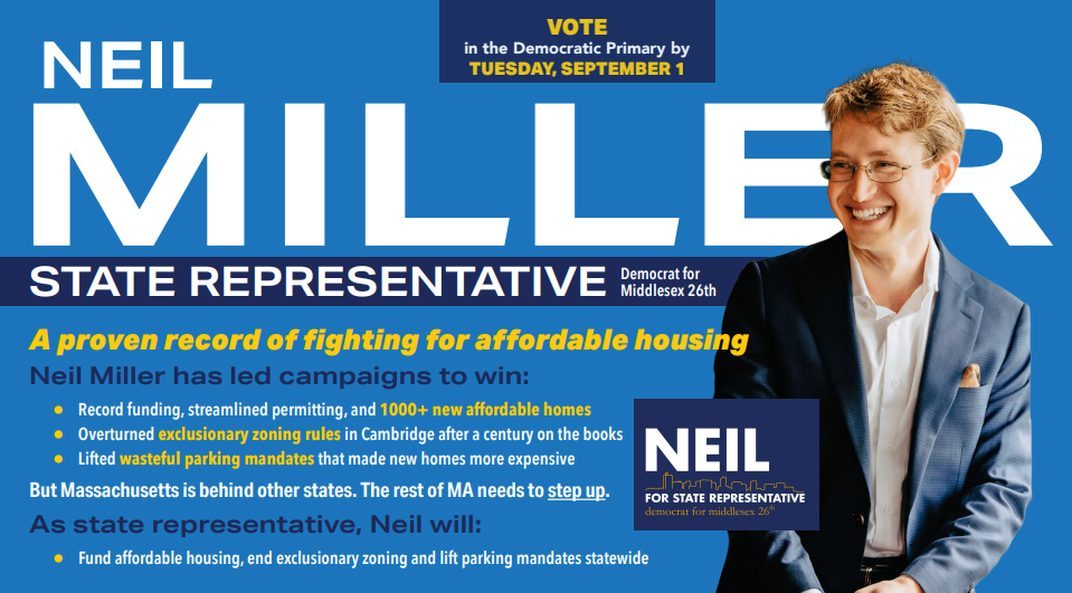
Neil Miller mailer, front panel: A proven record of fighting for affordable housing

Extensive references for each of the four points above can be found in our full response. It isn't hard to see that our legislature has failed to address our housing crisis. That's why voters are ready to hold long-time legislators accountable. On September 1, hundreds of our neighbors will be displaced by rent increases when their leases turn over. This year, for the first time in a decade, September 1 will also let voters decide whether to stay with their current State Representative - or choose a new voice who will address housing affordability with urgency and honesty.